Review


codon-optimized human orc1, orc2, orc3, orc4, orc5  (Thermo Fisher)


Bioz Verified Symbol Thermo Fisher is a verified supplier
Bioz Manufacturer Symbol Thermo Fisher manufactures this product  

  • Logo
  • About
  • News
  • Press Release
  • Team
  • Advisors
  • Partners
  • Contact
  • Bioz Stars
  • Bioz vStars
  • 90

    Structured Review

    Thermo Fisher codon-optimized human orc1, orc2, orc3, orc4, orc5
    Codon Optimized Human Orc1, Orc2, Orc3, Orc4, Orc5, supplied by Thermo Fisher, used in various techniques. Bioz Stars score: 90/100, based on 1 PubMed citations. ZERO BIAS - scores, article reviews, protocol conditions and more
    https://www.bioz.com/result/codon-optimized human orc1, orc2, orc3, orc4, orc5/product/Thermo Fisher
    Average 90 stars, based on 1 article reviews
    codon-optimized human orc1, orc2, orc3, orc4, orc5 - by Bioz Stars, 2026-05
    90/100 stars
    Images


    Similar Products

    90
    Thermo Fisher codon-optimized human orc1, orc2, orc3, orc4, orc5
    Codon Optimized Human Orc1, Orc2, Orc3, Orc4, Orc5, supplied by Thermo Fisher, used in various techniques. Bioz Stars score: 90/100, based on 1 PubMed citations. ZERO BIAS - scores, article reviews, protocol conditions and more
    https://www.bioz.com/result/codon-optimized human orc1, orc2, orc3, orc4, orc5/product/Thermo Fisher
    Average 90 stars, based on 1 article reviews
    codon-optimized human orc1, orc2, orc3, orc4, orc5 - by Bioz Stars, 2026-05
    90/100 stars
      Buy from Supplier

    90
    Thermo Fisher human orc5
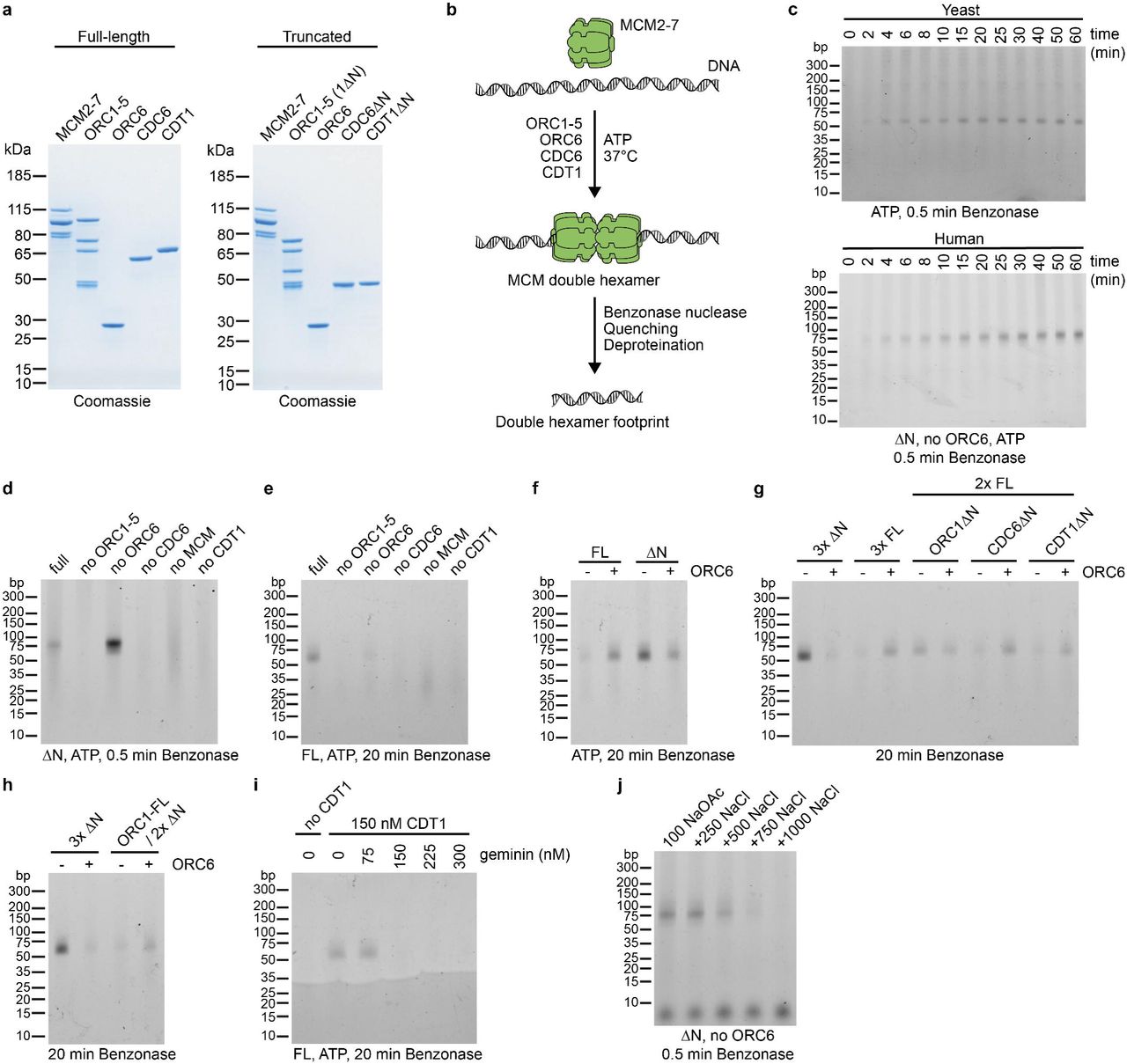
    a , Purified human MCM loading proteins analysed by SDS-PAGE and Coomassie staining. Full-length proteins (left, FL) and truncated proteins (right, ΔN): ORC1ΔN, CDC6ΔN, CDT1ΔN. b , Outline of the nuclease footprinting assay. MCM loading reactions are treated with Benzonase followed by quenching with EDTA, SDS and proteinase K. Then DNA is purified by phenol-chloroform-isoamyl alcohol extraction and ethanol precipitation, resolved on a TBE polyacrylamide gel, and stained with SYBR Gold. c , Timecourse of yeast (top) and human (bottom) MCM loading reactions. d , Protein requirements for the DH footprint with truncated human proteins. e , Requirements of MCM loading with full-length proteins. f , Side-by-side comparison of the ORC6 dependency with full-length and truncated proteins. g , As f, testing conditions in which either <t>ORC1,</t> CDC6, or CDT1 was truncated and other proteins full-length. h , As f, with full-length ORC1 and truncated CDC6 and CDT1. i , Effect of geminin on full-length MCM loading reactions. CDT1 and geminin were pre-mixed before reactions were started. j , Salt stability of the DH. MCM was loaded for 30 minutes and then incubated in buffers containing the indicated concentrations of sodium chloride for 15 minutes, followed by dilution and Benzonase treatment.
    Human Orc5, supplied by Thermo Fisher, used in various techniques. Bioz Stars score: 90/100, based on 1 PubMed citations. ZERO BIAS - scores, article reviews, protocol conditions and more
    https://www.bioz.com/result/human orc5/product/Thermo Fisher
    Average 90 stars, based on 1 article reviews
    human orc5 - by Bioz Stars, 2026-05
    90/100 stars
      Buy from Supplier

    Image Search Results


    a , Purified human MCM loading proteins analysed by SDS-PAGE and Coomassie staining. Full-length proteins (left, FL) and truncated proteins (right, ΔN): ORC1ΔN, CDC6ΔN, CDT1ΔN. b , Outline of the nuclease footprinting assay. MCM loading reactions are treated with Benzonase followed by quenching with EDTA, SDS and proteinase K. Then DNA is purified by phenol-chloroform-isoamyl alcohol extraction and ethanol precipitation, resolved on a TBE polyacrylamide gel, and stained with SYBR Gold. c , Timecourse of yeast (top) and human (bottom) MCM loading reactions. d , Protein requirements for the DH footprint with truncated human proteins. e , Requirements of MCM loading with full-length proteins. f , Side-by-side comparison of the ORC6 dependency with full-length and truncated proteins. g , As f, testing conditions in which either ORC1, CDC6, or CDT1 was truncated and other proteins full-length. h , As f, with full-length ORC1 and truncated CDC6 and CDT1. i , Effect of geminin on full-length MCM loading reactions. CDT1 and geminin were pre-mixed before reactions were started. j , Salt stability of the DH. MCM was loaded for 30 minutes and then incubated in buffers containing the indicated concentrations of sodium chloride for 15 minutes, followed by dilution and Benzonase treatment.

    Journal: bioRxiv

    Article Title: MCM Double Hexamer Loading Visualised with Human Proteins

    doi: 10.1101/2024.04.10.588848

    Figure Lengend Snippet: a , Purified human MCM loading proteins analysed by SDS-PAGE and Coomassie staining. Full-length proteins (left, FL) and truncated proteins (right, ΔN): ORC1ΔN, CDC6ΔN, CDT1ΔN. b , Outline of the nuclease footprinting assay. MCM loading reactions are treated with Benzonase followed by quenching with EDTA, SDS and proteinase K. Then DNA is purified by phenol-chloroform-isoamyl alcohol extraction and ethanol precipitation, resolved on a TBE polyacrylamide gel, and stained with SYBR Gold. c , Timecourse of yeast (top) and human (bottom) MCM loading reactions. d , Protein requirements for the DH footprint with truncated human proteins. e , Requirements of MCM loading with full-length proteins. f , Side-by-side comparison of the ORC6 dependency with full-length and truncated proteins. g , As f, testing conditions in which either ORC1, CDC6, or CDT1 was truncated and other proteins full-length. h , As f, with full-length ORC1 and truncated CDC6 and CDT1. i , Effect of geminin on full-length MCM loading reactions. CDT1 and geminin were pre-mixed before reactions were started. j , Salt stability of the DH. MCM was loaded for 30 minutes and then incubated in buffers containing the indicated concentrations of sodium chloride for 15 minutes, followed by dilution and Benzonase treatment.

    Article Snippet: The coding sequences of human ORC1, ORC2, ORC3, ORC4 and ORC5 were codon-optimised for S. frugiperda , synthesised (GeneArt, Thermo Fisher Scientific) and subcloned into modified pBIG1 vectors that contain a pLIB derived polyhedrin expression cassette.

    Techniques: Purification, SDS Page, Staining, Footprinting, Extraction, Ethanol Precipitation, Comparison, Incubation

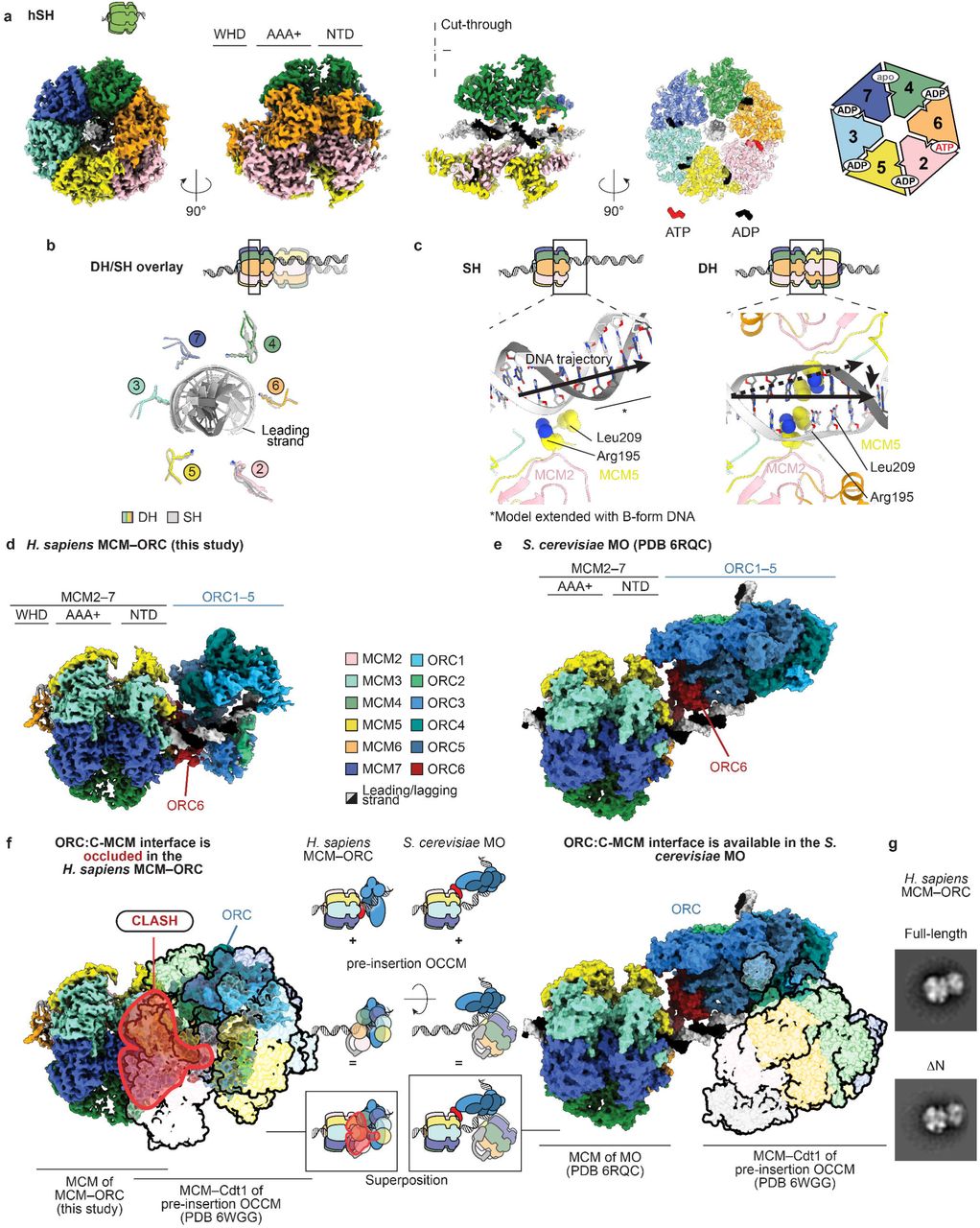
    a , Surface rendering and cut-through view of a hSH loaded onto duplex DNA. The C-terminal ATPase site is shown with nucleotides bound at subunit interfaces. b , A superposition of PS1 pore loops and DNA extracted from hDH and hSH show the same configuration. c , MCM hexamer dimerisation changes the path of duplex DNA leading to untwisting and opening of the double helix. d , Surface rendering of the hMO* structure. e , Surface rendering of the yMO structure highlights a different configuration of the ORC complex compared to hMO*. ORC6 is bridges N-terminal MCM and ORC1-5 in both structures. f , A steric clash obtained by modelling the pre-insertion yOCCM (PDB entry 6WGG) demonstrates that hMO* cannot support recruitment of a second MCM, unlike what was observed for the yMO complex. g , Truncated and full length ORC1, CDC6 and CDT1 yield the same hMO* complex, as observed by negative stain 2D averaging.

    Journal: bioRxiv

    Article Title: MCM Double Hexamer Loading Visualised with Human Proteins

    doi: 10.1101/2024.04.10.588848

    Figure Lengend Snippet: a , Surface rendering and cut-through view of a hSH loaded onto duplex DNA. The C-terminal ATPase site is shown with nucleotides bound at subunit interfaces. b , A superposition of PS1 pore loops and DNA extracted from hDH and hSH show the same configuration. c , MCM hexamer dimerisation changes the path of duplex DNA leading to untwisting and opening of the double helix. d , Surface rendering of the hMO* structure. e , Surface rendering of the yMO structure highlights a different configuration of the ORC complex compared to hMO*. ORC6 is bridges N-terminal MCM and ORC1-5 in both structures. f , A steric clash obtained by modelling the pre-insertion yOCCM (PDB entry 6WGG) demonstrates that hMO* cannot support recruitment of a second MCM, unlike what was observed for the yMO complex. g , Truncated and full length ORC1, CDC6 and CDT1 yield the same hMO* complex, as observed by negative stain 2D averaging.

    Article Snippet: The coding sequences of human ORC1, ORC2, ORC3, ORC4 and ORC5 were codon-optimised for S. frugiperda , synthesised (GeneArt, Thermo Fisher Scientific) and subcloned into modified pBIG1 vectors that contain a pLIB derived polyhedrin expression cassette.

    Techniques: Staining

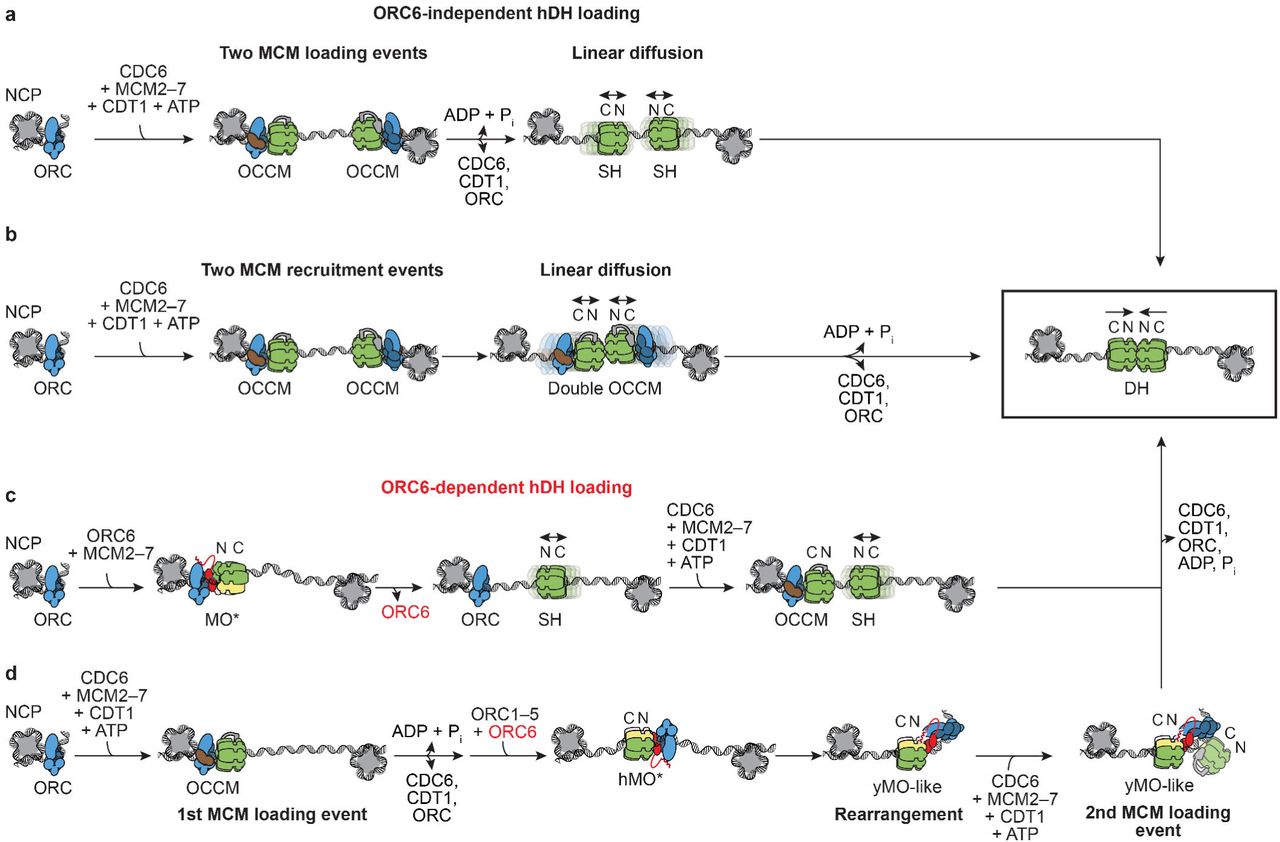
    a , MCM can be loaded via an ORC6 independent pathway, via two inverted hOCCM complexes that load two hSHs in a process that requires ATP hydrolysis. Free diffusion along duplex DNA would then lead to hDH formation. b, In a variation of the same mechanism, two hOCCMs assembled around duplex DNA are free to diffuse and form a dOCCM. ATP hydrolysis then promotes hDH formation. c, MCM loading with full-length ORC1 can occur in an ORC6 dependent manner and might go through the hMO* intermediate. hMO* might recruit a hSH through an ORC6 interaction with N-terminal MCM. Following hSH release, the same ORC could recruit a second hSH via C-terminal MCM interaction (hOCCM intermediate), resulting in two N-terminally facing hSHs that can assemble a hDH. d, Alternatively, a first hSH could be loaded via OCCM. ORC6 would then interact with the N-terminal domain of hSH forming hMO*. A structural change would then occur, which causes hMO* to transition to a yMO-like state, where hORC is competent for the recruitment of a second hSH, eventually leading to hDH formation. We have however not observed a yMO-like complex formed with human proteins.

    Journal: bioRxiv

    Article Title: MCM Double Hexamer Loading Visualised with Human Proteins

    doi: 10.1101/2024.04.10.588848

    Figure Lengend Snippet: a , MCM can be loaded via an ORC6 independent pathway, via two inverted hOCCM complexes that load two hSHs in a process that requires ATP hydrolysis. Free diffusion along duplex DNA would then lead to hDH formation. b, In a variation of the same mechanism, two hOCCMs assembled around duplex DNA are free to diffuse and form a dOCCM. ATP hydrolysis then promotes hDH formation. c, MCM loading with full-length ORC1 can occur in an ORC6 dependent manner and might go through the hMO* intermediate. hMO* might recruit a hSH through an ORC6 interaction with N-terminal MCM. Following hSH release, the same ORC could recruit a second hSH via C-terminal MCM interaction (hOCCM intermediate), resulting in two N-terminally facing hSHs that can assemble a hDH. d, Alternatively, a first hSH could be loaded via OCCM. ORC6 would then interact with the N-terminal domain of hSH forming hMO*. A structural change would then occur, which causes hMO* to transition to a yMO-like state, where hORC is competent for the recruitment of a second hSH, eventually leading to hDH formation. We have however not observed a yMO-like complex formed with human proteins.

    Article Snippet: The coding sequences of human ORC1, ORC2, ORC3, ORC4 and ORC5 were codon-optimised for S. frugiperda , synthesised (GeneArt, Thermo Fisher Scientific) and subcloned into modified pBIG1 vectors that contain a pLIB derived polyhedrin expression cassette.

    Techniques: Diffusion-based Assay
